


If Darwin and Wolf are already on your radar, you don’t need convincing — you need details. And if you’re just now hearing about these two remote seamounts at the northern edge of the Galapagos archipelago, keep reading: Darwin and Wolf Galapagos diving represents some of the most concentrated, large-animal pelagic action on the planet, accessible only by liveaboard, and everything you need to know to plan your trip is right here.
Where Are Darwin & Wolf?
Darwin Island sits approximately 44 kilometers north of Wolf Island, and Wolf itself lies roughly 191 kilometers northwest of Isabela — the nearest major island. These aren’t casual detours. Getting there takes the better part of a day’s sailing from the central archipelago, and that isolation is the entire point.
Both sites are submerged volcanic structures that intercept the nutrient-rich Cromwell Current pushing up from depth, along with the warmer Panama Current from the northeast and the cold Humboldt Current from the south. The collision of these systems generates an upwelling engine that fuels a food chain dense enough to attract aggregations of large predators year-round. Darwin Island diving and Wolf Island diving are productive precisely because of this geography — it’s not luck, it’s physics.
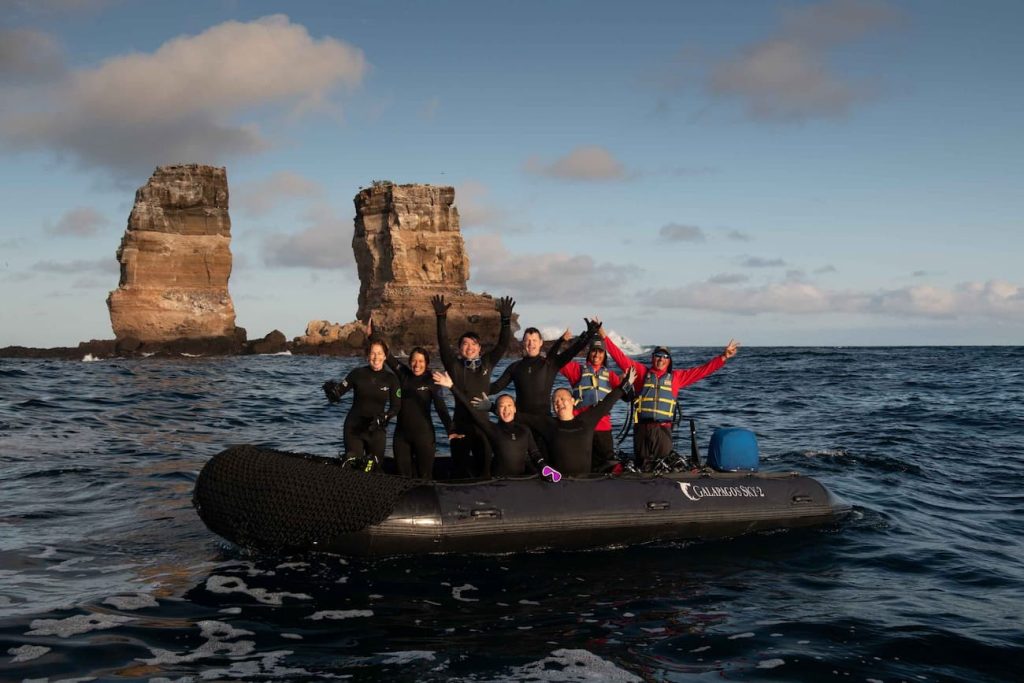
Both sites fall within the Galapagos Marine Reserve, which means access is tightly regulated. Operators must hold permits, groups are capped, and extraction of any kind is prohibited. That regulatory framework is a big part of why the marine life density here remains exceptional.
What Makes Diving Here Legendary
Schools of Hammerhead Sharks
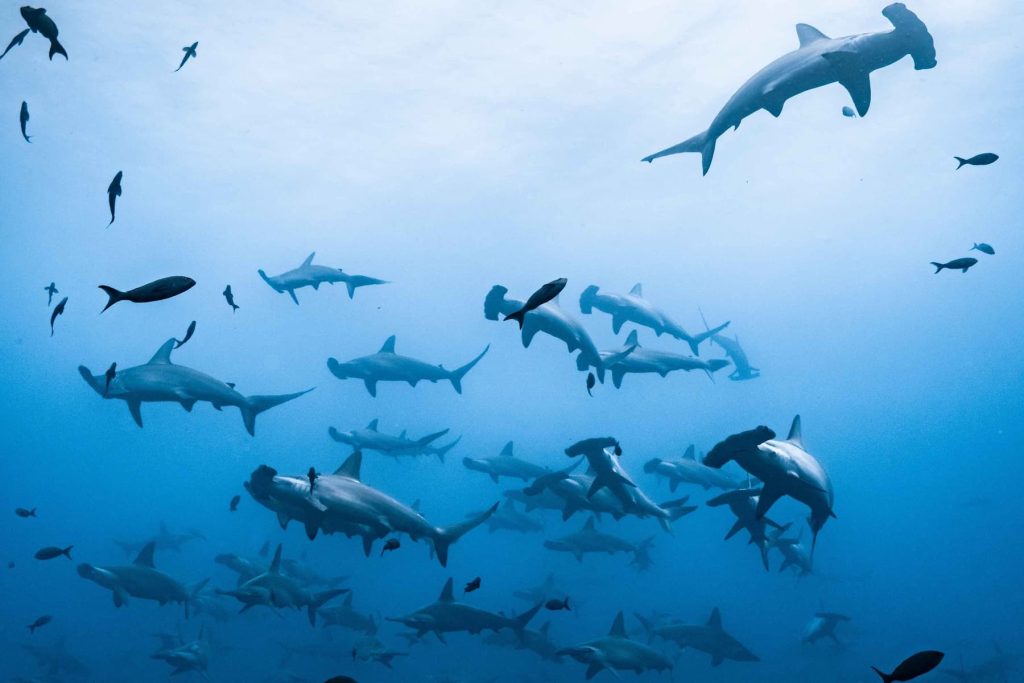
Scalloped hammerheads are the signature of Galapagos shark diving, and Darwin and Wolf are where you find them in the numbers that justify the trip. Schools of dozens to several hundred individuals are a realistic expectation, not a highlight reel exception. They aggregate along the thermocline, often at 20–30 meters, which puts them within consistent range. Positioning yourself downcurrent and staying still typically delivers the closest encounters.
Whale Sharks
Diving with whale sharks in the Galapagos is one of the primary reasons Darwin and Wolf draw serious divers from around the world. The cold season (roughly June through November) brings the highest concentration of whale sharks — predominantly large, gravid females. Research suggests they use Darwin’s Towers (formerly Darwin Arch)area as a critical habitat, possibly related to pupping. You’ll find them on the surface, at mid-water, and occasionally coming in close around cleaning stations.
Galapagos Sharks & Silky Sharks
Galapagos sharks are a constant presence at both sites — curious, confident, and worth your full attention. Silky sharks appear in large schools particularly at Wolf, sometimes hundreds strong, often filling the water column in a way that’s genuinely difficult to describe to anyone who hasn’t experienced it. This is multi-species shark diving at its best.
Eagle Rays, Mantas & Dolphins
Beyond the sharks, the biomass here covers every layer. Spotted eagle rays move through in formation. Manta rays work the cleaning stations. Bottlenose and common dolphins are regulars, occasionally joining divers mid-water. The diversity isn’t just wide — it’s stacked, with different species occupying every depth zone simultaneously.
Massive Biomass & Current-Swept Reefs
The reef structures at Darwin and Wolf are covered in black coral, gorgonians, and encrusting sponges that thrive in high-current environments. The biomass that supports the pelagic visitors is visible even on the rock: enormous schools of creolefish, bigeye jacks, and yellowfin tuna that move in and out of frame like living weather systems. This is best diving in Galapagos territory — the kind of underwater experience that resets your baseline.
Who Is This Diving For?
Darwin and Wolf are advanced diving, full stop. The currents here are not decorative — they drive the entire ecosystem, and they’ll test you on every dive. Negative entries, surge, haloclines that affect buoyancy, and rapidly shifting current direction are standard operating conditions. You need to be comfortable with all of it before you get in the water.
What the right diver looks like for this expedition:
- Minimum Advanced Open Water certification
- 50–100 logged open water dives
- Experience diving in strong currents
- Excellent buoyancy control
- Comfortable with negative (sometimes rapid) back-roll entries and descents from small boats
- Able to remove gear in the water and board small boats in choppy conditions
- Recent dive experience (a refresher course is recommended if you haven’t dived in 6+ months)
- Nitrox certification is highly recommended
Diving in the Galapagos is exhilarating but demanding. Strong currents, variable visibility, and water temperatures ranging from the low 60s to upper 70s °F require both confidence and preparation. Dive depths typically range from 20–30 meters (65–100 feet), and all dives aboard Galapagos Sky are strictly non-decompression diving — no exceptions.
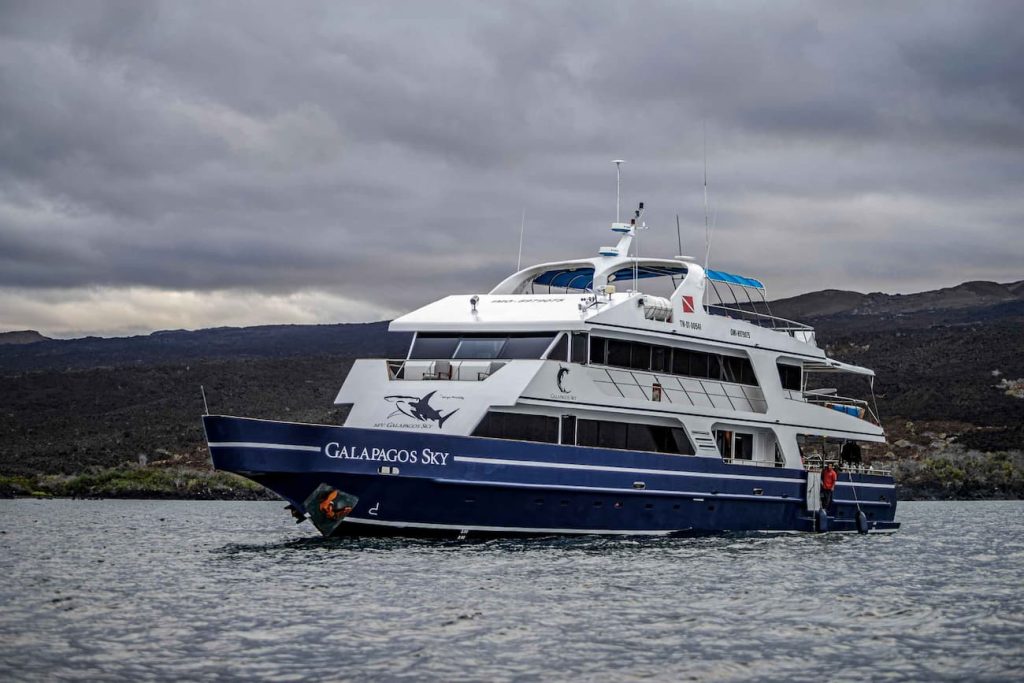
Galapagos Sky attracts divers who take this seriously. Our expert guides know these sites intimately — reading conditions carefully and positioning groups for extraordinary encounters while maintaining the highest safety standards. In environments like Darwin and Wolf, the difference between a spectacular dive and a stressful one often comes down to both the guide’s judgment and the diver’s technical readiness.
Why a Liveaboard Is Essential

There is no other way to dive Darwin and Wolf. Day boats cannot make the crossing — both sites are too remote and sea conditions too unpredictable for anything but a capable overnight vessel. A Galapagos liveaboard diving trip also gives you the multiple-dive access that actually matters at sites like these: you’re not rushing a single dive against a weather window, you’re working the site across several days, timing your dives to the tidal exchanges and current peaks that produce the most activity.
On Galapagos Sky, the liveaboard infrastructure is built around expedition-level diving without giving up comfort between dives. The dive deck is configured for efficient, fast turnarounds — you spend your surface intervals recovering, not waiting. Nitrox is available, equipment is well-maintained, and the dive guides manage your group with the kind of site knowledge that only comes from hundreds of dives at Darwin and Wolf specifically.
Best Time to Dive Darwin & Wolf
The Galapagos has two primary seasons, and both offer strong diving — just different experiences. Here’s what to expect across the year:
1. Warm Season (January–May): Water temps 24–28°C, lower visibility (10–20m), calmer seas. Whale shark sightings are possible but less reliable. Good for first-timers to the region.
2. Cool/Dry Season (June–December): Water temps 18–24°C, visibility 15–30m+, stronger currents. Peak whale shark season runs June through November. This is when hammerhead aggregations are largest and overall biomass is highest.
3. Whale shark peak (June–November): The concentration of large females at Darwin Arch during this window is well-documented. This is the priority period for divers whose primary goal is whale shark interaction.
4. Year-round: Hammerheads, Galapagos sharks, silkies, eagle rays, and dolphins are resident — no season leaves you without the core pelagic action.
Conservation & Marine Protection
The Galapagos Marine Reserve is one of the largest marine protected areas in the world, covering 133,000 square kilometers of ocean. Its existence is the primary reason Darwin and Wolf remain as intact as they are. No fishing, no extraction, tightly managed visitor numbers — these aren’t just regulations, they’re the reason you can still witness aggregations of this scale.
Galapagos Sky operates in full compliance with Galapagos National Park regulations and works actively with local conservation organizations. That means responsible briefings before every dive, strict no-touch protocols, and group sizes that protect site integrity without compromising the experience. Part of what you’re paying for is access to sites that are managed well enough to still be worth diving.
As part of Ecoventura’s conservation commitment, Galapagos Sky supports the Charles Darwin Foundation through the Galapagos Biodiversity & Education for Sustainability Fund (GBESF), contributing directly to scientific research and long-term marine protection in the archipelago.
Part of what you’re investing in is not just access — it’s stewardship. These sites remain extraordinary because they are managed with intention.
Book Your Galapagos Diving Liveaboard

Darwin and Wolf are not destinations you schedule casually. Galapagos Sky runs a limited number of departures each year, and berths at peak whale shark season fill months, even years, in advance. If you’re planning to dive into these sites, the time to act is now, not when you’re ready to finalize your calendar.
Request availability for upcoming departures, one of our Expedition Specialists can assist you planning your diving trip Contact here
If you’re ready to commit, head directly to our booking page — we’ll help you lock in the departure that works best.


